

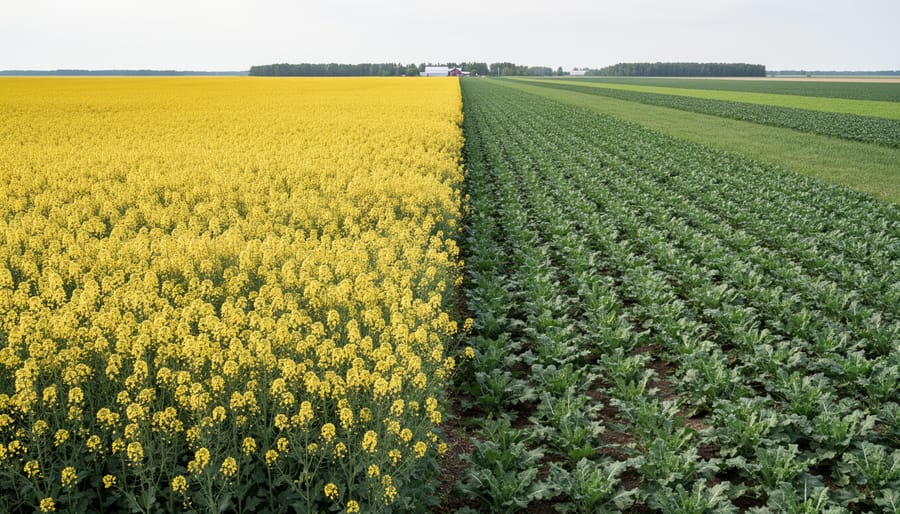
Monoculture farming is the agricultural practice of growing a single crop species across an entire field or farm year after year. If you drive through Alberta’s prairies and see nothing but canola stretching to the horizon, or pass field after field of continuous wheat, you’re witnessing monoculture in action.
This approach dominates modern agriculture for practical reasons. Specializing in one crop lets you streamline your equipment purchases, develop deep expertise in managing that specific plant, and negotiate better prices when buying inputs or selling harvest in bulk. A cattle operation that focuses solely on beef production or a grain farmer who plants exclusively spring wheat can master every detail of their chosen enterprise.
The numbers tell the story of monoculture’s reach. Across the Canadian prairies, thousands of operations have built their business models around this focused approach, and many have achieved impressive yields through specialized knowledge and targeted management.
But the conversation around monoculture has shifted considerably in 2026. What once seemed like straightforward efficiency now raises questions about soil health, pest resistance, and long-term sustainability. Some Alberta producers are reporting increased disease pressure after years of continuous cropping, while others struggle with herbicide-resistant weeds that thrive in repetitive systems.
Understanding monoculture means looking beyond simple definitions to examine how this practice shapes everything from your soil biology to your bottom line. Whether you’re evaluating your current rotation or planning your next five years, knowing the full picture helps you make decisions that work for your land and your operation’s future.
Defining Monoculture Farming: More Than Just Single Crops
Monoculture farming means dedicating a field or operation to growing just one crop species at a time or raising a single livestock species. If you drive past a quarter-section planted entirely with canola this spring, you’re seeing monoculture. The same goes for a feedlot focused solely on cattle or a farm that plants nothing but wheat year after year.
The definition is broader than many people realize. Even if you rotate crops on the same field over the years, planting barley one season, canola the next, then wheat, you’re still practicing monoculture. The defining characteristic is what’s growing at any given moment, not what you’ll plant next year. That field of barley stands alone right now, without the biodiversity that comes from mixing multiple crops in the same space during the same season.
- Crop Monoculture
- Growing a single crop type on a field during one growing season, such as a quarter-section dedicated entirely to canola or wheat. This remains monoculture even if different crops are rotated across seasons.
- Livestock Monoculture
- Raising only one species of farm animal on an operation, like a ranch focused exclusively on beef cattle or a farm raising only hogs. The approach simplifies management and infrastructure requirements.
- Polyculture
- Growing multiple crop species together in the same field at the same time, or raising different livestock species on the same operation. This contrasts with monoculture’s single-species focus.
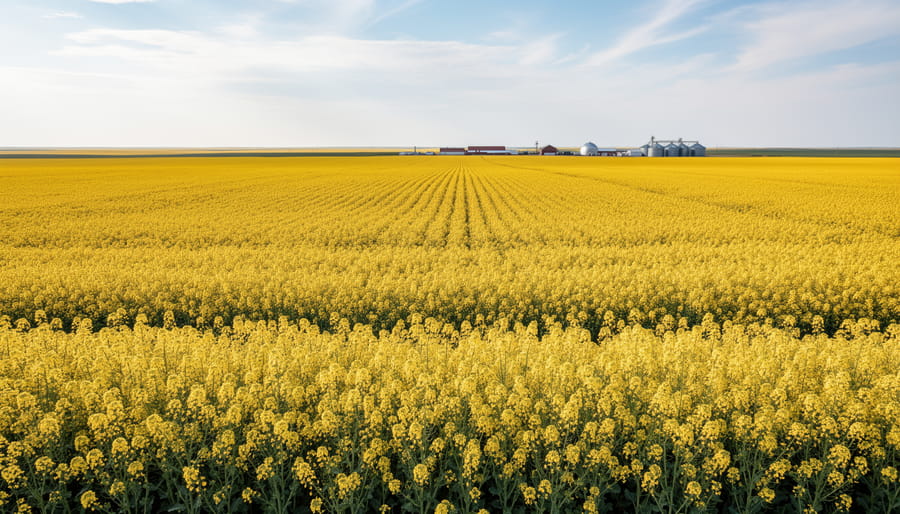
In Alberta, crop monoculture dominates grain operations. Fields stretch for acres with uniform stands of canola, wheat, or barley, one species from fence line to fence line during each growing season. This pattern reflects both the province’s grain-focused agricultural economy and the practical realities of modern farming equipment designed for single-crop efficiency.
Livestock monoculture is equally prevalent. Most Alberta ranches specialize in cattle rather than mixing cattle with sheep, goats, or other species. Hog operations raise pigs exclusively. This specialization allows producers to develop deep expertise with one species and invest in specific infrastructure, handling facilities, feed systems, breeding programs, tailored to that animal’s needs.
The core principle stays consistent across both crops and livestock. You’re managing one species at a time, creating uniformity across your operation. That simplicity delivers real advantages, but it also creates specific vulnerabilities that Alberta farmers increasingly navigate as they plan for long-term sustainability.
Why Monoculture Became the Standard in Alberta Agriculture
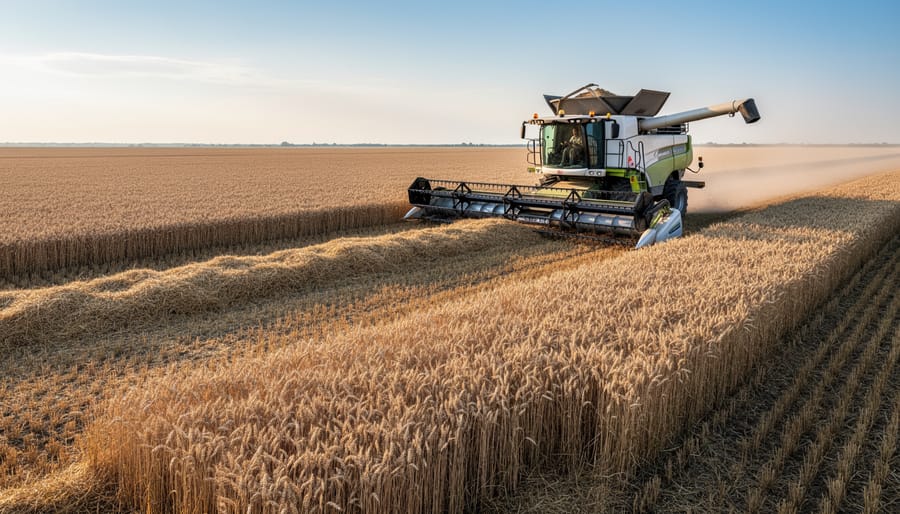
Monoculture farming took root in Alberta for straightforward economic and practical reasons that made sense for the province’s sprawling agricultural landscape. During the mid-20th century, mechanization revolutionized farming operations across the prairies. Large-scale equipment designed for specific crops, seeders calibrated for wheat or canola, combines optimized for grain harvest, worked best when farmers planted uniform fields. Running a single machine across hundreds of acres of identical crops eliminated the need to constantly adjust settings, swap attachments, or manage multiple planting schedules.
The efficiency gains went beyond equipment. Growing one crop type let farmers develop deep expertise in that specific commodity. A wheat specialist could master optimal seeding rates, fertilizer timing, and harvest windows without juggling competing demands from multiple crops. This specialization extended to storage facilities, marketing relationships, and agronomic knowledge.
Alberta’s grain export economy reinforced these patterns. Global buyers wanted consistent, large-volume shipments of specific crops. Alberta crops trends reflect how market demands shaped planting decisions, with certain commodities dominating year after year because they commanded reliable prices and established infrastructure.
Economies of scale sealed monoculture’s position as standard practice. Bulk purchasing seed, fertilizer, and crop protection products for one commodity cost less per acre than sourcing inputs for diverse crops. Larger fields of uniform crops reduced transition time between operations and maximized the return on expensive machinery investments.
The same logic applied to Alberta’s ranching operations, where focusing on cattle production allowed ranchers to optimize facilities, feed programs, and breeding knowledge for one species. The infrastructure Alberta built, grain elevators positioned for specific crops, feedlots designed for cattle, created momentum that kept monoculture as the path of least resistance for farmers building viable operations across the province.
The Operational Advantages: When Monoculture Makes Sense
Understanding monoculture’s genuine advantages helps Alberta farmers make informed decisions rather than following one-size-fits-all advice. For many operations, especially large-scale grain producers and established cattle ranches, the efficiency gains remain substantial and measurable.
The equipment argument isn’t just theoretical. A central Alberta wheat farmer running 2,000 acres can justify investing in specialized seeding equipment, combine settings optimized for one crop, and grain storage tailored to wheat specifications. Switching between barley, canola, and wheat would mean adjusting or replacing equipment multiple times per season, sacrificing hours and increasing maintenance costs. When you’re working against tight harvest windows, that specialization translates directly to getting crops off before weather turns.
Knowledge depth matters too. A rancher who’s raised Angus cattle for 15 years develops expertise that a diversified livestock operation can’t match as easily. They learn the subtle health indicators specific to that breed, understand exactly when those animals reach optimal market weight, and build relationships with buyers who value consistent quality. The same applies to crop specialists who can identify disease pressure in canola at early stages or know precisely when their wheat variety hits the protein targets buyers pay premiums for.
Market relationships favor consistency. Grain elevators and meat processors prefer working with producers who deliver predictable volumes of uniform quality. An Alberta farmer who consistently delivers 500 tonnes of milling-quality wheat builds trust and often secures better contracts than someone offering varied smaller lots. Commodity markets reward scale and reliability.
The simplified management shouldn’t be dismissed either. One crop means one planting schedule, one set of inputs to order and apply, one harvest timeline to coordinate with custom operators or crew. For operations where labor is tight or the owner works off-farm during parts of the year, this simplicity can make the difference between sustainable farming and burnout.
These advantages are real. The question isn’t whether they exist, but whether they outweigh the challenges for your specific operation, soil, and long-term goals.
The Environmental and Economic Challenges Alberta Farmers Face
Pest and Disease Pressure
When you plant the same crop in the same field season after season, you create an all-you-can-eat buffet for specialized pests and diseases. Without the natural checks that biodiversity provides, a single wheat midge outbreak or fusarium infection can sweep through an entire field before you’ve had time to respond. Research confirms that monocultures face significantly higher risk of disease and pests because they lack the mix of plant and animal species that naturally limit spread through competition and predation.
For Alberta farmers, this vulnerability hits close to home. Wheat stem sawfly, bertha armyworm, and clubroot in canola thrive when they find uninterrupted stretches of their preferred host crop. Each growing season with the same crop strengthens pest populations in your soil and surrounding areas, building pressure that demands increasingly aggressive management. The absence of beneficial insects and predators, which diverse plantings support, means you’re fighting these battles largely alone, often reaching for chemical controls more frequently than diversified operations need to.
Chemical Input Demands and Water Quality
Monoculture systems typically require higher volumes of pesticides and herbicides than diversified farms because pests and weeds face fewer natural checks. When the same crop occupies a field repeatedly, resistant pest populations build up, often demanding stronger or more frequent chemical applications to achieve control. These inputs don’t stay put. Rainfall and irrigation carry pesticide residues into ditches, creeks, and eventually rivers, degrading water quality across agricultural watersheds.
For Alberta farmers, this matters beyond the field boundary. The province’s waterways support fisheries, recreation, livestock watering, and downstream communities. Herbicide runoff can harm aquatic plants and disrupt ecosystems, while certain pesticides affect fish and amphibian populations. Nitrate leaching from heavy fertilizer use, common in nutrient-depleted monoculture soils, compounds the problem by fueling algae blooms that deplete oxygen and kill fish.
Chemical dependence also creates a cost spiral. As pest resistance develops, farmers face rising input expenses without proportional yield gains. Many Alberta operations now track application rates closely, not just for regulatory compliance but because water quality directly impacts their neighbours and their own long-term land value.
Soil Health Decline
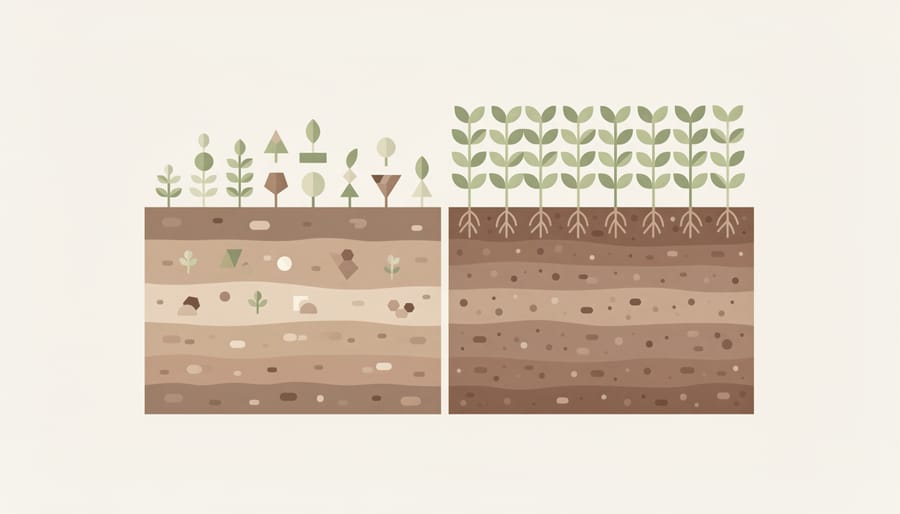
When you plant wheat every season, you’re essentially asking the same nutrients from the same soil depth, year after year. Each crop species has specific nutrient requirements and root patterns. Wheat draws heavily on nitrogen and phosphorus, while canola needs different ratios. Repeating the same crop depletes those particular nutrients faster than soil biology can replenish them, creating imbalances that synthetic fertilizers only partially address.
Beyond nutrient depletion, continuous monoculture breaks down soil structure itself. Without diverse root systems to create different pore channels and feed varied soil organisms, the physical architecture deteriorates. Proper straw management helps return organic matter, but when the same residue type enters the soil repeatedly, microbial diversity suffers. The living ecosystem that builds aggregates and maintains tilth needs variety.
Alberta farmers have watched this play out as Alberta soil dries-up and compaction increases in fields under long-term single-crop systems. The soil loses its resilience, holding less water and requiring more inputs to produce the same yields.
What Alberta Farmers Are Doing Differently in 2026
Alberta’s farming community is tackling monoculture challenges through two distinct approaches: refining existing systems with technology and strategic management, or shifting toward more diversified operations. Both paths show promise when matched to specific land, market, and resource conditions.
In the Peace Country, several canola producers are using AI in farming tools to optimize their monoculture operations. Variable-rate technology allows them to apply precise amounts of fertilizer based on soil nutrient mapping, reducing inputs while maintaining yields. These farmers combine satellite imagery with soil sensors to identify stress zones before visible symptoms appear, catching disease pressure early and targeting interventions to specific field areas rather than blanket applications across entire sections.
Other Alberta producers are incorporating cover crops between cash crop cycles without abandoning their primary focus. A wheat farmer near Lethbridge now plants winter rye after harvest, which builds organic matter and breaks disease cycles while still dedicating the majority of field time to wheat production. This hybrid approach maintains operational efficiency while addressing soil health concerns that develop under continuous single-crop systems.
We’re still primarily a cattle operation, but adding a small flock of sheep changed how we manage our pastures and reduced our parasite treatments by nearly 40 percent.
Some ranchers are testing multi-species grazing to combat the parasite loads and pasture degradation common in cattle-only operations. A producer in the Foothills now rotates cattle with sheep and occasionally goats, disrupting lifecycle patterns of livestock-specific parasites while utilizing different vegetation layers more completely.
The Parkland region has seen producers add pulse crops like lentils and peas into previously all-cereal rotations. These nitrogen-fixing crops reduce fertilizer requirements for subsequent wheat or barley plantings while spreading market risk across multiple commodities. Farmers report the transition requires learning new crop management skills and sometimes acquiring different equipment, but several cite improved soil tilth and reduced herbicide resistance as worthwhile trade-offs.
Technology adoption is accelerating across both groups. Drone-based crop monitoring, precision application equipment, and data analytics help monoculture practitioners minimize environmental impacts while maintaining scale advantages. Those diversifying rely on similar tools to manage increased operational complexity across multiple crop or livestock species.
Understanding monoculture farming isn’t about choosing sides. It’s about equipping yourself with the knowledge to make the best decisions for your land, your operation, and your future in Alberta’s agricultural landscape. Whether you’re running a specialized grain operation that thrives on the efficiency of single-crop production, managing a cattle ranch, or exploring diversified approaches, what matters is making informed choices that align with your specific circumstances.
The conversations happening across Alberta in 2026 reflect a farming community that values both traditional practices and innovative solutions. Farmers are sharing what works, honestly discussing what doesn’t, and collaborating on approaches that address soil health, pest pressure, and market realities without dismissing the legitimate operational advantages that made monoculture the standard in the first place.
Your farming approach should fit your land, your resources, and your goals. Some operations continue to optimize monoculture systems with better soil management and technology. Others are transitioning toward diversification. Some farmers find themselves needing to sell farmland and reassess their agricultural path entirely. All these decisions are valid when they’re grounded in understanding rather than assumption. Keep asking questions, keep learning from your neighbours, and keep building the resilient agricultural future Alberta needs.