

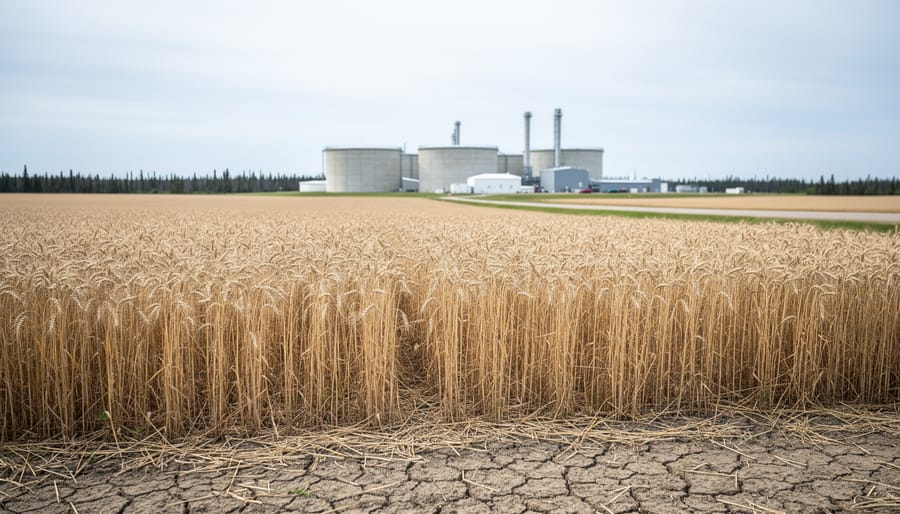
Nuclear waste poses serious risks to human health, agricultural land, and water systems because it remains dangerously radioactive for thousands of years and can contaminate the environment if storage systems fail. What is nuclear waste? It’s the byproduct of nuclear power generation and medical applications, containing isotopes that emit radiation capable of causing cancer, genetic mutations, and severe ecological damage.
For Alberta’s agricultural community, the stakes are particularly high. A single leak or accident at a storage facility can render farmland unusable for generations. Radioactive contamination doesn’t respect property boundaries. It seeps into groundwater, accumulates in soil, and enters the food chain through crops and livestock. The economic consequences alone can devastate farming operations, as contaminated land loses its value and productive capacity overnight.
The challenge isn’t theoretical. Communities across North America have wrestled with nuclear waste storage proposals, and the financial burden of cleanup often falls on taxpayers rather than the industries that created the waste. Storage facilities require constant monitoring and maintenance, with costs stretching across centuries.
Understanding these risks doesn’t mean rejecting all nuclear technology outright. It means demanding transparency, rigorous safety standards, and meaningful input from the agricultural communities who would bear the consequences of storage failures. Alberta’s farmers and ranchers have always been stewards of the land, and that responsibility includes protecting it from long-term contamination that could affect countless future generations.
The Core Problems: What Makes Nuclear Waste Dangerous
Nuclear waste presents three fundamental hazards that set it apart from other environmental contaminants agricultural producers may encounter. Understanding these dangers is essential for any land steward evaluating policies that could affect their operation for generations.
The first critical problem is time. High-level nuclear waste remains dangerously radioactive for thousands of years, some isotopes like plutonium-239 have half-lives exceeding 24,000 years. This means the waste generated today will still pose risks to farmland when your great-great-great-grandchildren’s descendants work that same soil. Unlike chemical contamination that may break down over decades, or soil degradation that can be remedied through conservation practices, nuclear radioactivity lasts millennia regardless of remediation efforts. No storage container or facility has ever been designed to guarantee containment over such timeframes.
The second issue is penetration. Radiation doesn’t stay put. It moves through soil profiles, leaches into groundwater, and travels through irrigation systems. Different types of radiation have different penetration capabilities, gamma rays can pass through several inches of soil, while alpha particles travel shorter distances but cause severe damage to living cells they contact. For farmers, this means contamination doesn’t remain at the surface where you might contain it. It infiltrates the root zone, enters water tables, and spreads through precisely the systems you depend on for crop production and livestock health.
The third danger is bioaccumulation. Radioactive isotopes mimic essential nutrients, strontium-90 behaves like calcium, cesium-137 like potassium. Plants absorb these isotopes from contaminated soil, livestock consume contaminated feed and water, and the radiation concentrates as it moves up the food chain. A cow grazing on slightly contaminated pasture accumulates far higher radioactive loads in her tissues and milk than exist in the soil itself. This accumulation effect means even low-level environmental contamination can render agricultural products unmarketable or unsafe, with no practical way to reverse the process once it begins.
Threats to Soil Health and Agricultural Productivity
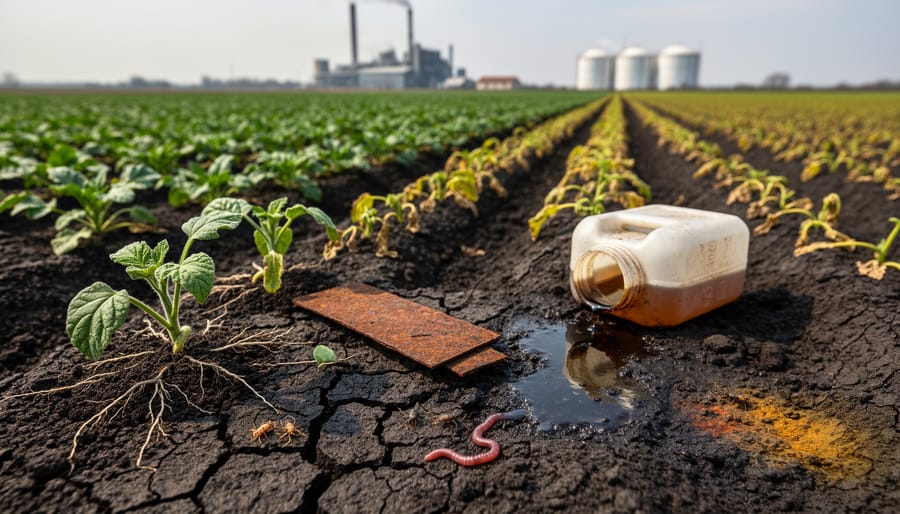
Radioactive contamination poses a fundamentally different threat than the soil challenges Alberta producers already navigate, like salinity or nutrient depletion. While those problems can be managed through agricultural soil management techniques, radioactive isotopes persist in soil for thousands of years, rendering land unusable for agriculture across multiple human lifetimes. The half-life of plutonium-239, a common component of nuclear waste, exceeds 24,000 years. No crop rotation, cover crop, or amendment can remediate that.
The contamination pathways are insidious. Plants absorb radioactive isotopes like strontium-90 and cesium-137 through their root systems because these elements chemically resemble calcium and potassium, nutrients crops need. Once in plant tissue, they concentrate as crops grow. Wheat, canola, and forage crops will pull these isotopes from soil just as readily as they absorb fertilizer. The soil health principles that build fertility and biological activity become irrelevant when the soil itself becomes a radiation source.
The impacts cascade through your operation in multiple ways:
- Crops concentrate radioactive elements in grain, forage, and vegetable tissues, making them unmarketable and unsafe
- Beneficial soil microorganisms suffer cellular damage from radiation exposure, disrupting nutrient cycling and organic matter decomposition
- Livestock consuming contaminated feed or forage accumulate radioactive isotopes in muscle tissue and milk, entering the food chain
- Even suspected contamination closes off export markets and organic certification, eliminating premium sales channels
Bioaccumulation compounds the problem up the food chain. Cattle grazing contaminated pasture store isotopes in their tissues. Predators and wildlife feeding in the area concentrate even higher levels. This isn’t a one-season setback you can recover from with better practices next year.
The permanence sets nuclear contamination apart from every other agricultural challenge. Heavy metal contamination from industrial activities is difficult but sometimes manageable over decades. Radioactive pollution operates on geological timescales. A farm contaminated today remains hazardous for your great-great-grandchildren and hundreds of generations beyond. The land you’ve stewarded, improved, and planned to pass down becomes a liability rather than an asset. No insurance policy, no government program, no agronomic innovation can reverse that loss.
Water Contamination Risks in Agricultural Watersheds
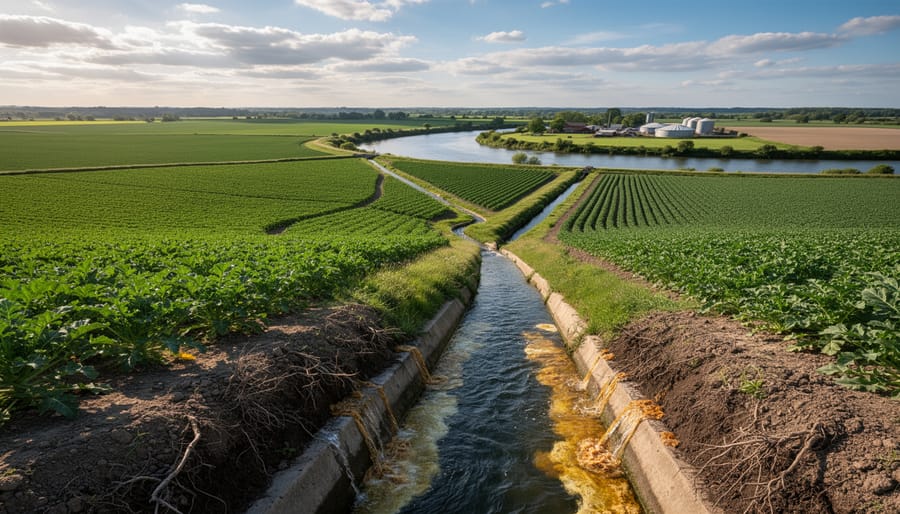
Water represents agriculture’s most critical resource, and nuclear waste poses unique threats to both groundwater reserves and surface water systems that farmers and ranchers depend on. Unlike many contaminants that degrade or can be filtered, radioactive materials persist for millennia and can penetrate water sources in ways that render them unusable for generations.
Leaching from storage facilities occurs gradually as containers corrode and geological barriers crack over decades or centuries. Radionuclides, radioactive elements like cesium-137, strontium-90, and iodine-131, dissolve into groundwater and migrate through aquifers. In Alberta, where many operations rely on well water for livestock and irrigation, this deep contamination would be catastrophic. Once radioactive material enters an aquifer, it spreads unpredictably through underground water channels, potentially affecting wells kilometers away from the source. There’s no practical way to clean an aquifer once contaminated.
Surface water faces immediate risks from transport accidents. A rail derailment or highway collision near a river, creek, or irrigation canal could release radioactive material directly into flowing water. Alberta’s interconnected watershed systems mean contamination spreads rapidly downstream, affecting multiple operations before response teams can even arrive. Livestock drinking from contaminated dugouts would absorb radiation. Irrigation water would carry it directly onto cropland and into produce.
The province’s existing water management challenges, drought cycles, allocation disputes, aging infrastructure, compound these risks. Communities already stretching limited water supplies can’t afford to lose access to entire watersheds. Yet current emergency response protocols aren’t designed for radioactive contamination in rural water systems, and the monitoring infrastructure to detect leaching simply doesn’t exist across agricultural regions.
Watershed-dependent communities face an impossible position: once contamination occurs, the water source that built their agricultural economy becomes a permanent hazard. No filtration system removes all radionuclides, and the cost of alternative water infrastructure falls on producers who never created the risk.
The Storage and Transportation Challenge
Why Storage Solutions Fall Short
Even the most advanced storage systems face one unavoidable problem: they must contain waste that remains hazardous for 10,000 years or more, yet no human-made container lasts that long. Steel and concrete degrade, typically within a few centuries. Corrosion, pressure shifts, and chemical reactions eventually compromise any barrier we can build.
Geological repositories, deep underground facilities, seem promising until you consider that the Earth itself isn’t stable over millennia. Seismic activity, groundwater flow patterns, and geological shifts change dramatically across the timeframes nuclear waste remains dangerous. What appears stable today may not be in 5,000 years.
Then there’s the monitoring burden. Someone has to watch these sites, maintain records, and respond to breaches, not for decades, but for hundreds of generations. Languages change, governments rise and fall, and institutional knowledge gets lost. We’re asking our great-great-great-grandchildren’s descendants to guard waste from decisions we’re making now, with no guarantee they’ll have the resources or even the awareness to do so safely.
Transportation Corridors Through Agricultural Lands
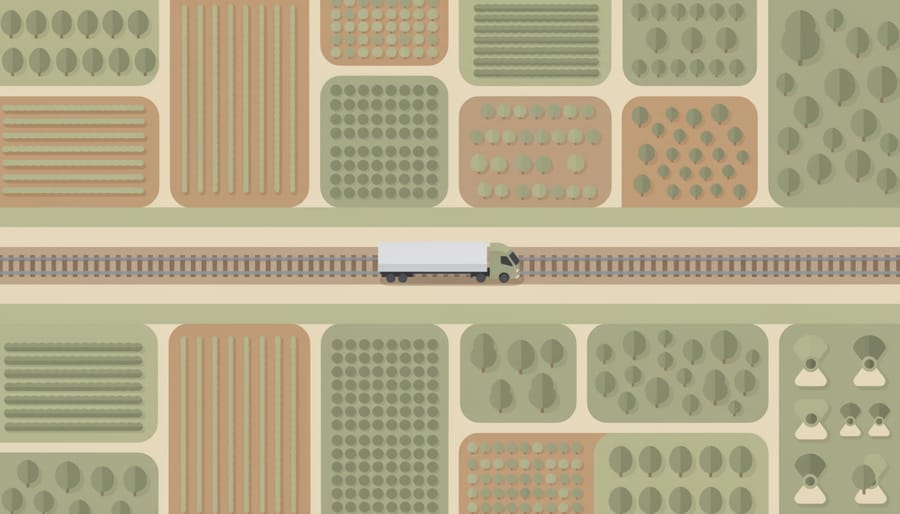
Nuclear waste doesn’t teleport to storage facilities, it travels by truck and rail through the same corridors that serve agricultural communities. In Alberta, Highway 2, Highway 16, and CP and CN rail lines cut directly through some of our most productive farmland. These aren’t theoretical routes; they’re the infrastructure we share daily with grain trucks, livestock haulers, and farm equipment.
The accident risk isn’t negligible. Highway collisions, derailments, and severe weather events happen regularly in rural areas. A containment breach during transport could contaminate miles of farmland depending on wind patterns and water flow. Unlike a fuel spill, radioactive contamination doesn’t dissipate, it persists.
Emergency response capacity in rural regions compounds the problem. Most county fire departments lack specialized equipment or training for radiological incidents. Response times from urban-based hazmat teams can exceed an hour, during which contamination spreads. Evacuation protocols that work in cities become impractical across sprawling agricultural operations with livestock that can’t be quickly moved.
Transport companies follow safety protocols, but human error and mechanical failure remain constants. One accident near irrigation infrastructure or a livestock operation could end farming on that land permanently, a risk imposed on rural communities without their meaningful consent in routing decisions.
Economic and Market Consequences for Producers
Nuclear contamination, or even the perception of it, can devastate a farm’s economic viability in ways conventional insurance never contemplates. Property values plummet when radioactive materials are stored or transported nearby. A 2012 study in Japan found land values near Fukushima dropped by 40 to 80 percent, even in areas where contamination levels remained below regulatory limits. For Alberta producers, this represents not just lost equity but eliminated borrowing power and the erasure of retirement plans built over decades.
Market access poses an even more immediate threat. Export markets often impose zero-tolerance standards for radioactive residues that exceed Canadian domestic thresholds. The European Union and several Asian countries maintain detection limits that would exclude products from any region with documented contamination events, regardless of how minor. Organic certification bodies will revoke credentials if radioactive materials are detected in soil or water sources, effectively ending premium market access overnight.
The burden falls hardest on rural communities that lack the legal resources and political capital of urban centers. Standard farm insurance policies explicitly exclude nuclear incidents, leaving producers to navigate complex liability frameworks that rarely provide adequate compensation. The Price-Anderson Act in the United States caps nuclear industry liability, forcing affected parties to accept predetermined settlements that don’t reflect true agricultural losses, lost production years, destroyed breeding programs, or generational land stewardship ended.
Neighboring operations suffer too, as the stigma of proximity affects entire marketing regions. A contamination event doesn’t respect property lines, and buyers won’t distinguish between the affected farm and the one next door. The financial consequences extend far beyond the initial incident, persisting through market memory long after cleanup attempts.
Intergenerational Impact: A Legacy We Cannot Reverse
When you hand over a farm to the next generation, you pass along more than assets. You transfer knowledge, relationships, and responsibility for land that should remain productive for those who come after. Nuclear waste inverts this most fundamental agricultural covenant.
A single batch of high-level radioactive waste remains hazardous for roughly 10,000 years. That spans 400 generations of farm families. The descendants who will manage your land in the year 4000, 6000, or 8000 cannot consent to the risk we create today. They inherit a threat without choice, consultation, or fair warning.
This violates everything agriculture stands for. Farmers and ranchers build soil health season by season, protect water sources for future use, and invest in infrastructure that outlasts them. The goal is always to leave the land better, or at minimum, no worse. Nuclear waste does the opposite. It burdens hundreds of future generations with a danger they did not create and cannot eliminate.
No document we write, no warning system we construct, can reliably communicate across such spans. Languages change. Nations rise and fall. The very concept of recordkeeping transforms. Yet the contamination persists, indifferent to whatever societies come next.
Alberta’s agricultural voice has always championed long-term stewardship over short-term convenience. That principle demands we question any practice that transfers permanent risk to people who cannot refuse it.
What Alberta’s Agricultural Community Can Do
Understanding the risks nuclear waste poses to Alberta’s agricultural lands is the first step. The next is taking meaningful action to protect your operation, your community, and the land you’ll pass to the next generation.
Start by staying informed about nuclear energy proposals and waste management plans in Alberta. The Canadian Nuclear Safety Commission and Alberta’s energy ministry hold public consultations when new projects are proposed or transportation routes are established. Sign up for email notifications from these agencies and from agricultural organizations like the Agricultural Producers Association of Saskatchewan and Grain Growers of Canada, which track issues affecting rural land use. When consultation periods open, your input as a landowner and producer carries weight, but only if you participate.
Your municipal council and regional planning bodies make decisions about land use and infrastructure that can affect waste routing. Attend council meetings when energy projects are discussed. Ask direct questions about proposed transportation corridors, emergency response plans, and how agricultural interests are being protected. Local government often has more influence over routing decisions than producers realize.
Practical steps you can take right now include:
- Monitor provincial regulatory notices and environmental assessment processes for nuclear-related proposals
- Engage with your municipal council on land use decisions that could affect waste transport routes
- Join agricultural advocacy coalitions that are tracking nuclear policy and representing rural interests
- Document baseline environmental conditions on your property, including water quality testing and soil samples
That last point matters more than it might seem. If contamination ever occurs, proving your land was clean beforehand becomes critical for any compensation claim. Baseline documentation protects your legal position.
Collective voice amplifies individual concerns. Connect with other producers in your region who share these worries. Agricultural organizations gain negotiating power when they represent unified rural opposition to unsafe practices. Consider building alliances with environmental groups and Indigenous communities who often face similar land protection challenges. These partnerships strengthen everyone’s position in policy discussions.
Support research and policy development for energy alternatives that don’t create perpetual waste streams. When government seeks input on energy strategy, make it clear that agricultural producers want solutions that don’t compromise land and water for millennia. Alberta’s agricultural community has always been innovative, that same forward-thinking approach applies to energy policy.
You have every right to protect your land. Energy needs are real, but so is your responsibility to the soil, water, and future farmers. Informed, organized producers can shape policy in ways that respect both.
Frequently Asked Questions
Can contaminated land ever be farmed again?
In practical terms, no. Radioactive contamination persists for thousands of years, and no remediation technique can restore soil to safe agricultural use. Once contaminated, farmland becomes permanently unusable for food production.
What happens if a transport accident occurs near my operation?
An accident would trigger immediate evacuation protocols and long-term access restrictions. Your ability to work your land, access livestock, or sell products would be suspended indefinitely pending contamination assessments that could take months or years.
Who is liable if contamination affects my livestock or crops?
Liability frameworks remain inadequate and untested at scale. While nuclear operators carry insurance, coverage limits often fall short of actual agricultural losses, and legal processes can drag on for decades while your operation sits idle.
How far away is safe from nuclear waste storage or transport routes?
There’s no definitive safe distance. Groundwater contamination can travel miles from a source, and airborne particles from an accident can spread across entire watersheds depending on weather conditions.
These questions reflect the real uncertainty agricultural producers face. The transportation of nuclear waste creates risks that don’t respect property lines, and the consequences fall disproportionately on rural communities with limited resources to respond or recover.
What makes this particularly challenging is the information gap. Detailed routing plans, emergency response capabilities in remote areas, and realistic compensation frameworks often aren’t made public until after decisions are finalized. By then, your window to influence routing away from prime agricultural land has closed.
The alternatives question matters too. Wind and solar energy produce no long-lived toxic waste, though they have their own land-use considerations. These technologies continue improving in efficiency and cost-effectiveness, offering paths that don’t saddle future generations with an unmanageable hazard. Alberta’s agricultural community has a stake in supporting energy solutions that don’t threaten the long-term viability of farming and ranching.
Alberta’s agricultural community doesn’t have the luxury of simple answers when it comes to energy policy. We understand that powering our province requires difficult decisions and trade-offs. But understanding the real, lasting dangers of nuclear waste isn’t fearmongering, it’s responsible land stewardship.
The risks we’ve examined aren’t theoretical. They’re measured in centuries of radioactivity, in contaminated water that can’t be uncontaminated, in farmland that can never be farmed again. These aren’t problems future technology will easily solve. They’re burdens we’d be placing on our children’s children, and their children after them.
Your voice matters in these conversations. When you speak up at consultations, when you ask hard questions about transportation routes and storage timelines, when you stand with your neighbours to protect agricultural lands, you’re exercising the kind of collective strength that has always defined Alberta’s farm community.
You know your land. You know what it means to care for something bigger than yourself, to pass it forward in better shape than you found it. That knowledge gives you not just the right, but the responsibility, to demand energy solutions that don’t compromise the land that feeds us all.