

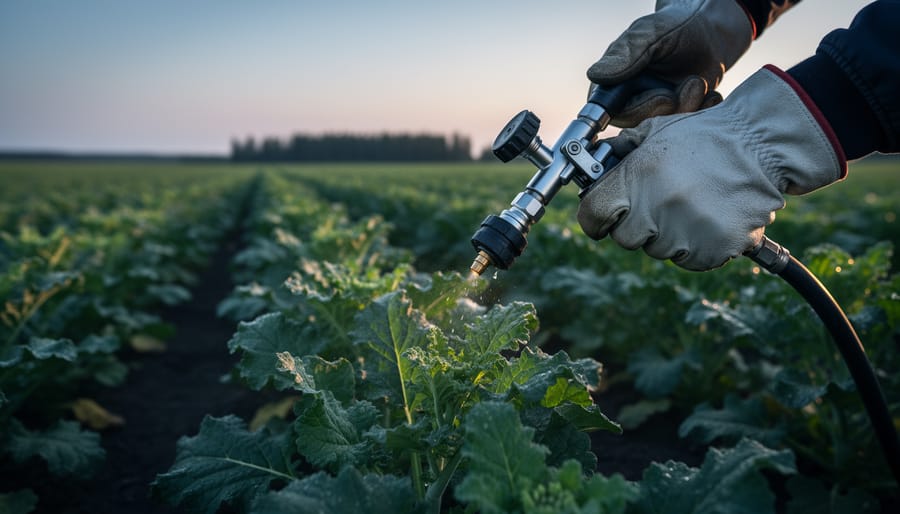
Pesticides shield crops from insects, weeds, and disease, but their environmental cost runs deeper than most Alberta producers realize. Every application sends ripples through soil health, water systems, and beneficial insect populations that underpin long-term farm productivity.
The numbers tell a sobering story. Neonicotinoid residues persist in prairie soils for months after application, disrupting microbial communities that fix nitrogen and break down organic matter. Runoff from treated fields carries chemicals into irrigation networks and watersheds, affecting aquatic life downstream. Pollinators critical to canola and pulse crops face sublethal exposure that weakens colonies, even when application timing follows label directions.
Here’s what matters for your operation: understanding these impacts isn’t about abandoning crop protection. It’s about making informed choices that protect both your yields and the land you’ll pass to the next generation.
Modern precision agriculture offers a middle path. Variable rate technology cuts chemical use by targeting only problem areas. Biological controls and integrated pest management strategies reduce reliance on synthetic inputs without sacrificing effectiveness. Alberta producers are already proving these approaches work at commercial scale, maintaining profitability while measurably reducing environmental footprint.
This isn’t regulatory pressure or outside judgment. It’s practical information about how pesticides move through farm ecosystems and what you can do about it. The science matters because your soil health, input costs, and long-term sustainability depend on getting pest management right.
The solutions exist. Let’s examine what the research shows and how Alberta farmers are adapting without compromising their bottom line.
The Legacy of Silent Spring: How Our Understanding Has Evolved
In 1962, Rachel Carson’s Silent Spring jolted the world awake to what pesticides were doing to the environment. Her meticulous research documented how DDT and similar chemicals were silencing bird populations, contaminating water systems, and accumulating in the food chain. The book sparked public outcry that eventually led to a ban on DDT in North America and helped launch the modern environmental movement.
The warning was clear: chemicals designed to kill pests don’t stop at field boundaries, they ripple through entire ecosystems in ways we’re still uncovering today.
Carson’s work fundamentally changed how we think about agricultural chemicals and their long-term consequences. Yet here’s the uncomfortable reality for Alberta farmers: despite six decades of environmental awareness and regulatory changes, Canada uses more pesticides than ever before. We’ve replaced DDT with newer formulations, but overall application rates have climbed, not fallen.
This isn’t about pointing fingers at farmers. You’re operating in a system that demands higher yields, tighter margins, and constant productivity gains. Pesticides became essential tools for meeting those demands. But the environmental questions Carson raised haven’t disappeared, they’ve grown more complex.
Today’s challenge is different from Carson’s era. We have better science, more refined products, and greater awareness of environmental impacts. We also have precision technology, biological alternatives, and integrated management strategies that weren’t available to previous generations. The question facing Alberta’s farming community isn’t whether to abandon modern agriculture, but how to maintain productive operations while understanding and reducing the environmental footprint of pesticide use. That starts with knowing exactly what those impacts are.
Direct Environmental Impacts: What’s Happening Beyond Your Fields
Pollinator Decline: The Bee Crisis Hitting Alberta
The rapid decline of essential pollinators like bees is one of the most measurable ways pesticides affect the environment, and it hits close to home for Alberta farmers. Neonicotinoid insecticides and other common agricultural chemicals have been directly linked to bee population crashes, disorienting and killing the very insects that many of our crops depend on for reproduction. This isn’t just an environmental concern, it’s an economic one that threatens farm productivity across the province.
Alberta’s canola industry alone relies heavily on pollinator activity. Wild and managed bees contribute substantially to canola yields, and their decline means reduced seed set and lower harvests. Beyond canola, crops like alfalfa, sunflowers, and pulse varieties all need healthy pollinator populations to reach their full potential. When you reduce pollinator numbers, you’re directly cutting into the productivity of these operations.
The science shows that even sublethal pesticide exposure weakens bees’ immune systems, disrupts their navigation, and reduces colony survival rates. As pollinators decline in Alberta and across Canada, farmers face a productivity challenge that goes beyond individual fields. Native bumblebees and solitary bees, which are often more effective pollinators than honeybees for certain crops, are particularly vulnerable because they lack the managed hive protections that commercial beekeepers can provide.
The good news? Understanding this connection allows you to time applications more strategically, choose less harmful alternatives when possible, and create pollinator-friendly zones that support both bee populations and your bottom line.

Water Systems and Aquatic Life
When pesticide runoff harms aquatic life in Alberta’s waterways, the damage extends far beyond fish counts. Chemical applications designed to stay on your fields rarely do. Rain events, irrigation, and spring snowmelt carry residues into ditches, creeks, and rivers that flow through agricultural regions. Once there, pesticides disrupt aquatic ecosystems at multiple levels.
Fish experience sublethal effects first. Reduced reproduction, impaired immune function, and disrupted hormone systems occur at concentrations well below levels that cause immediate death. Invertebrates that form the base of the aquatic food web prove even more sensitive. Mayflies, caddisflies, and other insects essential for trout and other species decline sharply when exposed to common agricultural chemicals.
Alberta’s irrigation districts face a compounded challenge. As Alberta soil dries up during drought years, farmers increase water application rates. Higher irrigation volumes mean more potential for chemical transport, especially on sloped land or fields near water bodies. The timing matters too. Spraying within 72 hours of expected rain or irrigation essentially guarantees runoff.
Practical mitigation starts with buffer zones. Even a five-metre vegetated strip between treated fields and waterways captures significant chemical load. Proper calibration prevents over-application that increases runoff risk. Monitor weather forecasts closely and delay applications when heavy rain threatens. For fields draining into sensitive waterways, consider rotating to crops requiring fewer chemical inputs or adopting spot-treatment approaches that limit total volumes applied.
Soil Health and Long-Term Land Productivity
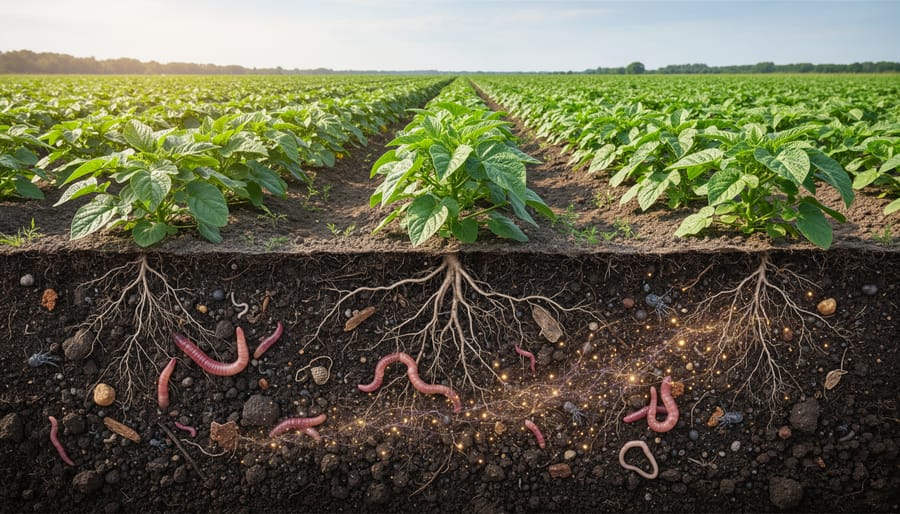
Your soil is more than dirt, it’s a living system that determines whether your land remains productive for the next generation. Pesticides affect this soil lifeblood in ways many farmers don’t see until yields start declining.
When herbicides, insecticides, and fungicides enter soil, they don’t disappear after controlling target pests. These chemicals disrupt the complex microbial networks that break down organic matter, fix nitrogen, and make nutrients available to crops. Beneficial fungi that help plants access phosphorus and water become collateral damage. Earthworms, nature’s tillers, die off or abandon treated areas, reducing soil aeration and drainage.
Research continues to document harm to soil ecosystems from repeated pesticide applications. The impact compounds over seasons: reduced microbial diversity means slower decomposition of crop residue, diminished nutrient cycling, and eventually, greater dependence on synthetic fertilizers to compensate for what healthy soil once provided freely.
For Alberta farmers managing land across generations, this creates a hidden cost. You might maintain yields today through increased inputs, but soil that’s lost its biological richness requires more intervention each year. Compaction worsens, water infiltration drops, and resilience during drought or excess moisture declines.
The economic reality hits when you calculate rising input costs against static or falling crop prices. Farmers who’ve tracked soil health metrics alongside pesticide use often notice the connection: healthier soil biology means lower fertilizer bills and better crop performance during weather extremes. Protecting your soil’s living component isn’t just environmental stewardship, it’s preserving the asset that underpins your operation’s profitability.
Human Health Connections: Protecting Your Family and Workers
Environmental concerns about pesticides extend beyond ecosystems to include verified health impacts for the people who work with them daily. Research has established connections between pesticide exposure and serious health conditions including certain cancers, reproductive harm, and impacts on child development. For Alberta farming families and agricultural workers, understanding these risks isn’t about creating alarm, it’s about making informed decisions that protect the people who depend on you.
The challenge is that health effects from pesticide exposure can be cumulative and slow to manifest. A seasonal worker applying chemicals in summer heat faces different exposure risks than someone operating precision spray equipment, but both need protection. Children on farming operations are particularly vulnerable because their developing bodies absorb chemicals differently than adults. Women of childbearing age working with or around pesticides face documented reproductive health concerns that deserve serious attention.
The good news is that protective measures work when applied consistently. Simple practices dramatically reduce exposure risk:
- Wear proper personal protective equipment during mixing and application, not just when convenient
- Ensure respirators are correctly fitted and filters are changed on schedule
- Designate specific clothing for pesticide work and wash it separately from family laundry
- Install handwashing stations near application areas so workers can clean up immediately
- Keep children and pregnant women away from treated areas during application and re-entry periods
- Store pesticides in locked facilities away from living spaces and food preparation areas
Many Alberta farmers are finding that worker safety programs that seemed burdensome at first become routine quickly. Training sessions, posted re-entry intervals, and equipment maintenance schedules protect your most valuable asset, the people who make your operation run. Investing in quality safety equipment and creating a culture where workers feel comfortable raising concerns about exposure pays dividends in health outcomes and reduced liability. Your family and crew deserve the same thoughtful planning you give to crop rotation and equipment maintenance.
Balanced Approaches: How Alberta Farmers Are Adapting
Across Alberta, innovative farmers are proving you can protect both productivity and the environment. These approaches aren’t theoretical exercises, they’re working strategies being refined in fields right now.
Integrated pest management (IPM) forms the foundation of many successful transitions. Rather than calendar-based spraying, IPM relies on scouting, threshold monitoring, and targeted interventions. Tom Richter, who farms near Lethbridge, reduced his herbicide use by 40 percent after implementing regular field scouting. He applies treatments only when pest populations reach economic thresholds, not as preventive blankets. The payoff shows in his input costs and soil health metrics.
Precision agriculture brings data-driven efficiency to pesticide application. GPS-guided sprayers equipped with smart technologies now allow farmers to vary application rates within a single field, targeting problem areas while reducing overall chemical use. Variable-rate technology cuts waste and environmental exposure simultaneously. Drone imagery helps identify pest hotspots before they spread, enabling spot treatments instead of field-wide applications.
Biological controls offer another proven pathway. Beneficial insects, trap crops, and companion planting reduce pest pressure naturally. Central Alberta grain farmers are experimenting with beetle banks, permanent strips of native grasses that harbor predatory insects feeding on aphids and other crop pests. These approaches work best when combined with crop rotation and diverse plantings that disrupt pest cycles.
Strategic timing matters enormously. Applying herbicides during optimal weather conditions, minimal wind, proper temperature, appropriate soil moisture, maximizes effectiveness while minimizing drift and runoff. A well-maintained straw management system supports this approach by creating better soil conditions that reduce reliance on chemical inputs over time.
Cover cropping between cash crops suppresses weeds mechanically, cutting herbicide dependence. Red clover, winter rye, and other species outcompete weeds while building soil organic matter and supporting beneficial microbes.
These farmers aren’t abandoning modern agriculture. They’re refining it, using pesticides as precise tools rather than broad-spectrum insurance policies. The environmental benefits come alongside economic ones: lower input costs, improved soil resilience, and reduced regulatory risk.
Practical Steps: Starting Your Transition Today
You don’t need to overhaul your entire operation overnight. Start with a clear-eyed assessment of where you stand and where small changes can make a measurable difference. Here’s how to begin reducing your environmental footprint while protecting your yields:
- Map your current pesticide use across each field, recording product names, application rates, timing, and the pest pressure that prompted each treatment.
- Identify your highest-volume applications and the fields receiving the most frequent treatments, these are your priority targets for reduction.
- Review last season’s weather data and pest scouting records to spot patterns where you might have applied preventively rather than in response to actual threats.
- Calculate the cost per acre of your pesticide program, including product, fuel, labor, and equipment wear, knowing the true economics helps you evaluate alternatives.
- Flag any applications made near water sources, pollinator habitat, or organic neighbors, as these carry higher environmental risk and deserve immediate attention.
Once you’ve completed this audit, pick one or two manageable changes for the upcoming season. You might reduce your broadcast herbicide rate by 20% in a test strip, switch to spot spraying for low-pressure weeds, or delay your first application until field scouting confirms economic thresholds.
Keep detailed records of everything. Note weather conditions, pest populations before and after treatment, yield comparisons, and any unexpected challenges. This documentation becomes invaluable evidence of what works on your land and helps you refine your approach each year.
Alberta Agriculture offers free integrated pest management workshops and access to agronomists who understand local conditions. Their Growing Forward programs sometimes provide funding for precision application technology or soil health initiatives that reduce pesticide dependence. Connect with your regional Agricultural Service Board to learn what support is available.
Don’t underestimate the value of talking with neighbors who’ve already started this transition. Many Alberta farmers are quietly experimenting with reduced-input approaches and are willing to share what they’ve learned, both successes and failures. Local Soil Conservation groups and commodity organization field days offer practical insights you won’t find in any manual.
Start small, measure results, and build confidence through evidence gathered on your own operation.
Understanding how pesticides affect the environment isn’t about abandoning the tools that have helped Alberta farmers feed the world. It’s about making informed decisions that protect both your operation’s future and the land you’ll pass to the next generation. The farmers already adapting their practices, integrating precision technology, and reducing unnecessary applications are proving that productivity and stewardship aren’t opposing forces.
Your experience matters in this conversation. When you share what works, whether it’s a successful IPM strategy or a spray timing adjustment that cut your pesticide use by half, you strengthen the entire farming community. These practical insights often prove more valuable than any research report.
Technology continues opening new doors. From biological controls to AI-powered application systems, innovation is giving Alberta farmers more options than ever to minimize environmental impacts while protecting yields. The producers embracing these tools today are positioning themselves to lead, not just in production, but in the sustainable practices increasingly valued by the local food movement and export markets alike.
Your land, your expertise, your future. Understanding the environmental impacts of pesticides gives you the power to farm smarter, not harder.